Founder Blindspots - Part 1:
Your Beta Customers Are Your First Customers

"Most founders think their first sales challenge is finding customers. It isn't.
Their first sales challenge is turning their first users into enthusiastic advocates."
One of the biggest sales blindspots I see in early-stage technology companies has nothing to do with lead generation, pricing, or closing deals.
It starts much earlier—during the beta.
Founders spend months (sometimes years) building an MVP. When they're finally ready to put it in front of real users, they find a handful of companies willing to participate in a beta program and breathe a sigh of relief.
"Great. Now we'll get feedback."
Not quite.
What you've actually acquired isn't just a group of testers. You've acquired your first customers.
Those beta participants will form opinions about your company long before they ever decide whether to buy from you. They'll decide whether your team listens, whether you're responsive, whether the product solves a meaningful problem, and whether they would recommend you to someone else.
Whether you're implementing enterprise software or launching a new SaaS platform, customers don't become advocates by accident. They become advocates through a deliberate experience.
Over the past three decades, I've worked with organizations implementing technology solutions ranging from startups to large enterprises. Regardless of the size of the company or the sophistication of the product, one pattern has remained remarkably consistent: the companies that treat their earliest customers as long-term partners build stronger products, stronger reputations, and stronger businesses.
The companies that simply "turn customers loose" to explore the product often miss that opportunity entirely.
That's why I consider beta planning to be a sales activity—not simply a product activity.
The Questions I Ask Every Founder
When a founder tells me they're preparing for beta, I start asking questions.
Product Readiness
How thoroughly has the product been tested internally?
Have you documented exactly what functionality is included in your MVP?
Have you identified the capabilities that are intentionally not included?
Beta Strategy
What do you hope to learn from your beta customers?
How long will the beta run?
How much time are you asking your customers to invest?
Who owns the relationship with each beta participant?
Customer Success
Who will onboard and train your beta users?
How will questions be answered?
How will feedback be collected and evaluated?
Will every requested feature be added, or do you have a process for prioritizing enhancements?
What is your plan for converting beta users into paying customers?
Will early adopters receive pricing incentives for investing their time?
Technology is only part of the solution. The customer experience determines whether people buy, stay, and recommend your product.
Why Do We Run a Beta?
One of my favorite questions to ask product teams is surprisingly simple:
"What is the purpose of your beta?"
Almost every time, I hear some version of the same answer:
"We're looking for feedback so we can improve the product."
That's certainly one outcome of a beta—but I don't believe it's the primary purpose.
If your beta ends with a better product but no paying customers, no advocates, and no implementation strategy, you've missed a tremendous opportunity.
A successful beta should accomplish three things:
Create customers who want to buy.
Create customers who want to recommend your product.
Generate feedback that strengthens your roadmap.
Notice that only one of those goals is about the product itself—The other two are about building a business.
First impressions matter.
I've watched many startups launch a beta by simply handing customers access to the product and waiting for feedback. If you want a recipe for failure, this is it.
When Beta efforts are planned and coordinated and expectations managed, the results are significant.
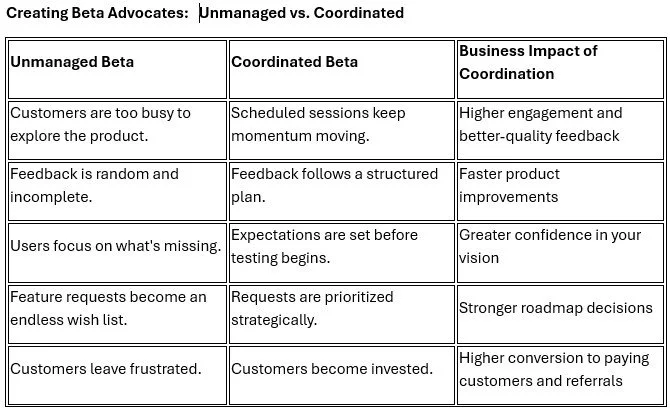
When Beta clients that see your effort to plan, be respectful of their time, and limit any surprises, you will be rewarded.
Why This Is Really a Sales Blindspot
Founders often believe sales begins after the product is finished.
In my experience, sales begins the moment someone agrees to invest their time helping you build a better product. Your beta customers are making an investment in your company long before they make a financial investment.
Every interaction during your beta shapes the story they'll tell about your business and your team. The way you treat your beta efforts is a reflection of how you will treat your paying customers.
By the end of the program, every participant should be able to say:
This product solves a real problem.
This team genuinely listens to customers.
I can see where this product is headed.
I want to continue using it.

If they aren't saying those things, your beta program wasn't simply incomplete—it was a missed sales opportunity.
Your first customers will define your reputation long before your marketing ever does.
Beta isn't product validation. It's the first step in Customer Success and the first step in Sales.
The best beta programs don't simply produce better software. They produce better customers.
Customers who understand your vision.
Customers who trust your team.
Customers who become your first advocates.
When participants understand what the MVP is designed to accomplish—and just as importantly, what it isn't—they spend their time evaluating the value you've created instead of being distracted by features that were never intended to be there.
Final Thought
Founders often think their first sale happens when someone signs a contract. But it happens much earlier—when someone believes enough in your company to invest their time helping you build something worthwhile.
That's why beta isn't the end of product development.
It's the beginning of your reputation.
Most founders don’t need more ideas—they need execution capacity that scales with them. That’s where fractional leadership and execution support can bridge the gap between where you are and where you need to be.